

One company, several homes: how global businesses pick their base today

Capital has always been on the move, settling where conditions suit it best. First, it followed the trade routes. Then, as finance went digital, it moved to the legal systems that offered the most attractive terms.
Established financial centres have maintained their standing through recent volatility, according to Knight Frank’s The Wealth Report 2026. The change is in how businesses use them: rather than moving from one jurisdiction to another, companies now add residencies in several places at once to build a diverse portfolio of bases.
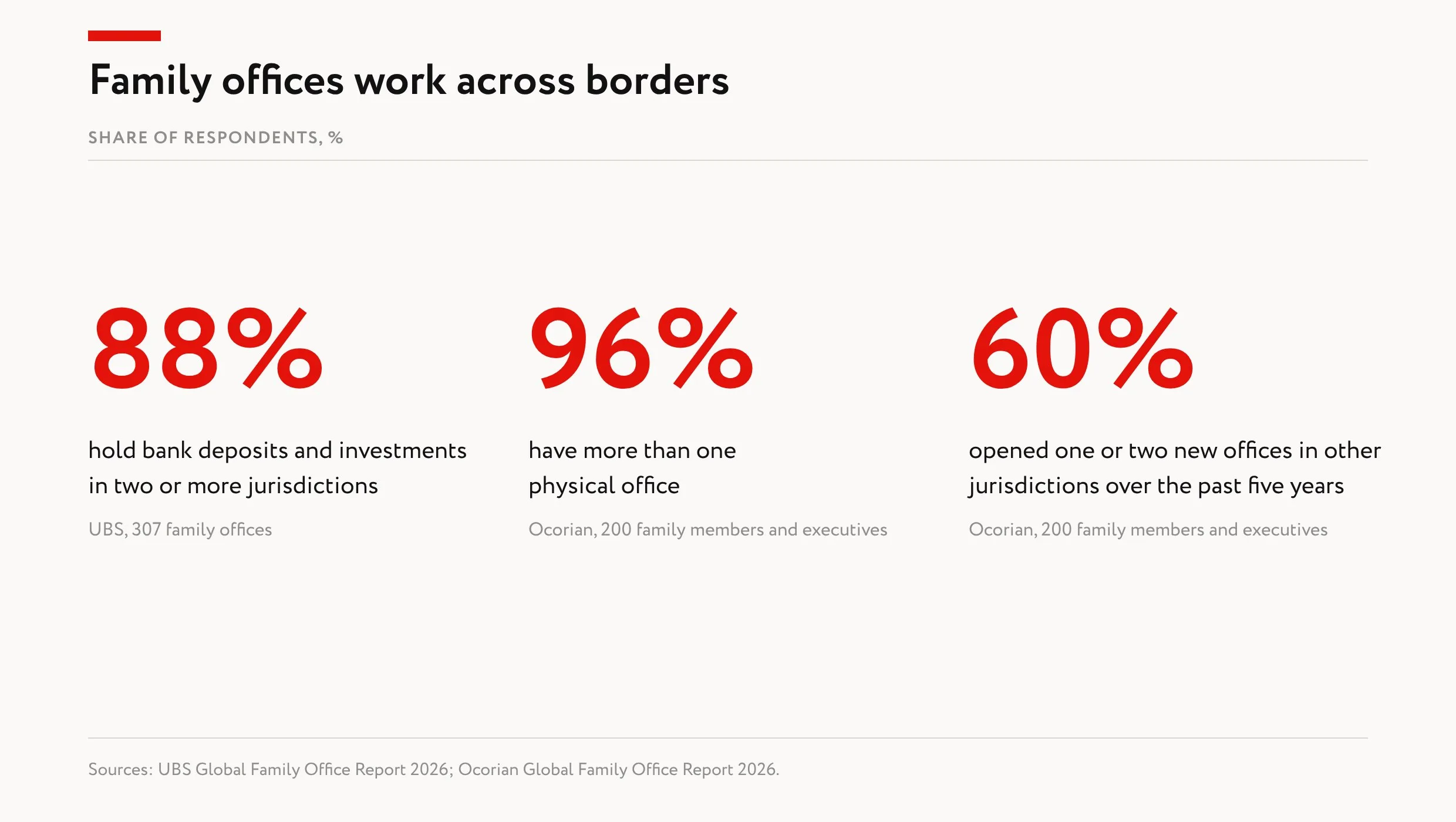
According to The Business of Expansion study by HSBC, companies increasingly treat geographic diversification as a hedge against trade uncertainty and see expansion abroad as a source of stability for their supply chains. Family offices, the private structures that manage the money of wealthy families, are doing the same: 96% of those surveyed by Ocorian, a provider of fund and corporate services, have more than one physical office.
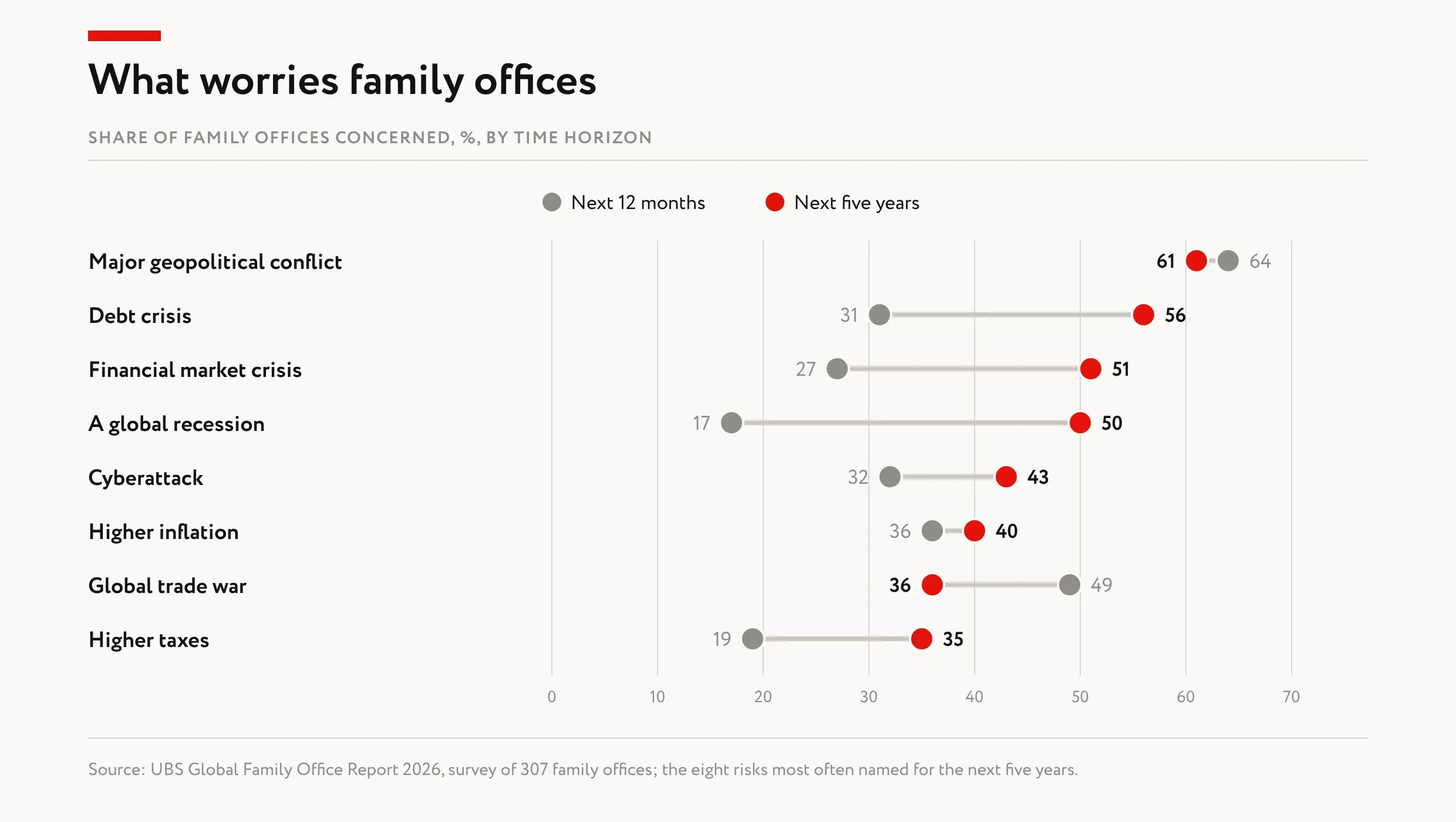
Both companies and family offices operate amid risks that experts describe as lasting rather than temporary. Sixty-one per cent of family offices name a major geopolitical conflict among their top concerns for the next five years, while 56% worry about a debt crisis, according to the latest Global Family Office Report by UBS.
Meanwhile, governments now make around 3,000 economic interventions a year – six times as many as a decade ago, according to Boston Consulting Group – highlighting the case that uncertainty has become a structural feature of international business.
More than one address
HSBC surveyed 2,700 companies with annual turnover of USD 50 million to USD 2 billion, finding that 77% of them plan to expand overseas in the next two years.
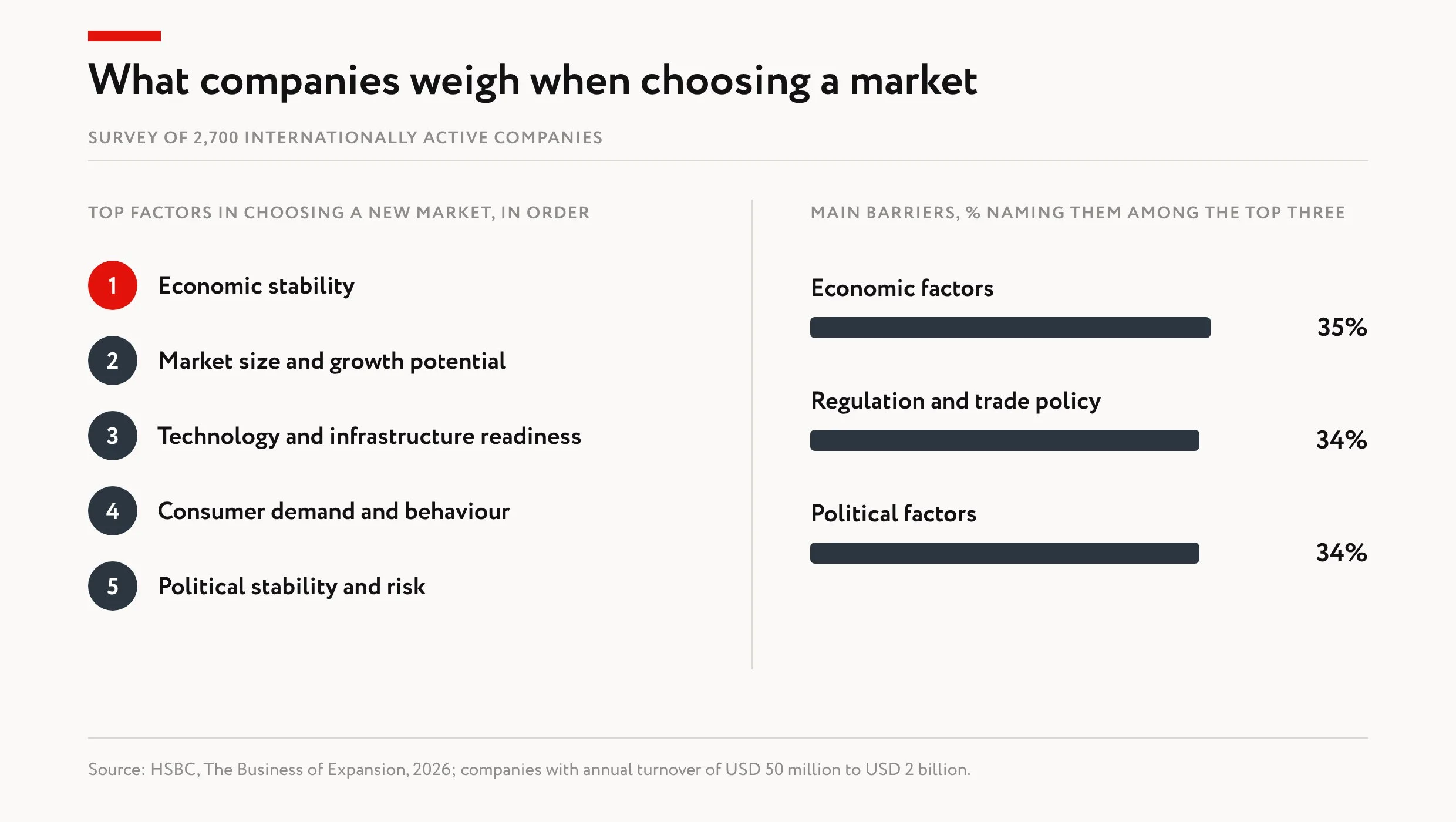
When choosing a new market, these companies rank economic stability the highest and give less priority to cost considerations and tax incentives. The authors note that cost minimisation is no longer the overriding concern; rather, businesses are building optionality into their supply chains by spreading them across more suppliers, partners and production sites.
Family offices also spread their assets and teams across several locations. UBS found that 88% hold bankable assets in two or more jurisdictions, after surveying 307 family office clients with an average family net worth of USD 2.7 billion. In the Ocorian survey of 200 family members and executives, 60% reported that they had opened one or two new offices in other jurisdictions over the past five years.
What businesses look for
Companies weigh several factors before entering a new market. The most important, per HSBC, are economic stability, market size and growth potential, as well as technology and infrastructure readiness, consumer demand, and political stability.
Priorities also differ by sector: professional services firms put access to a skilled workforce on a par with economic stability, and technology, media and telecoms companies pay particular attention to technology and infrastructure. HSBC adds that access to talent, innovation clusters, digital infrastructure and capital is becoming as important as access to customers.
Companies also look for regulatory predictability to make strategic decisions with confidence. English law is one of the answers to these concerns: it governs around 40% of global business and financial transactions. A number of international financial centres have adopted English law as the basis of their legal framework because of the contractual certainty, predictability and centuries of precedent it offers.
Rules for new technologies are another priority. In its 2026 review for financial institutions, the law firm Baker McKenzie says it expects jurisdictions with flexible, principles-based rules for artificial intelligence to see more investment in and development of the technology. The firm also notes that uncertainty over the regulatory status of crypto assets in the United States was, until recently, a major obstacle to their growth.
Practical concerns, like visas and quality of life, round out the list of what businesses and wealthy individuals increasingly look for in a jurisdiction today. While tax incentives remain important, companies prioritise stability and market fundamentals when choosing a strategy for long-term growth.
A new address in Central Asia
The emergence of a new generation of financial and investment territories in Central Asia has created fresh options for international businesses and investors seeking to diversify geographically.
Kyrgyzstan’s Tamchy SFIT officially launched in July with a number of international resident companies already on board. In a major recognition for the region, Tamchy SFIT was named the Asia-Pacific’s top Rising Star in the Global Free Zones of the Year 2026 awards by fDi Intelligence.
Central Asia is attracting attention thanks to a dynamically growing regional economy, increased connectivity, and the opportunities it offers as a historic crossroads between the Asian, European and Middle Eastern markets.
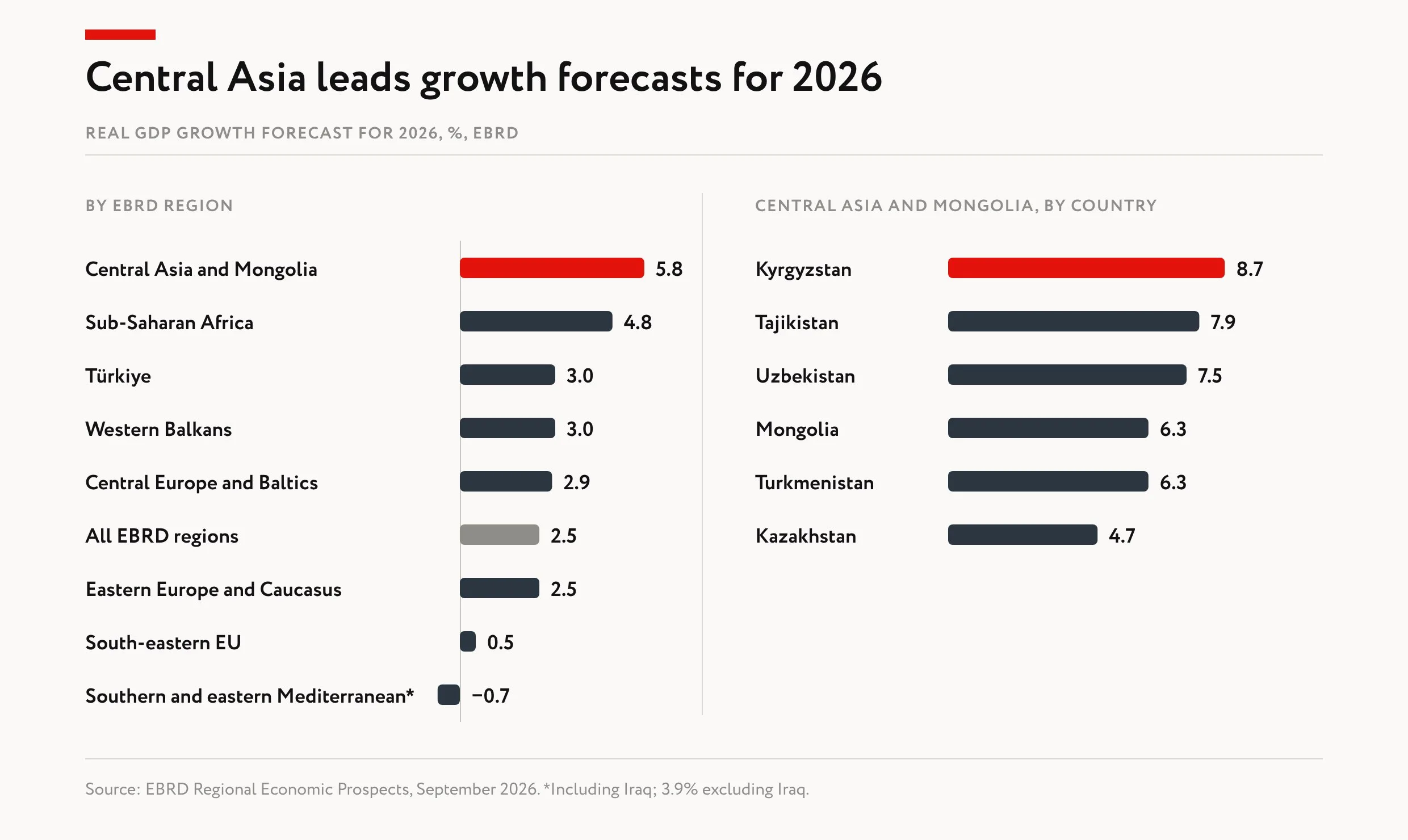
The European Bank for Reconstruction and Development (EBRD) forecasts real GDP growth of 5.8% in 2026 for Central Asia and Mongolia, the highest of all the regions where it invests and more than double its 2.5% average. It expects regional growth of 5.3% in 2027, and 8.7% and 7.0% for Kyrgyzstan over the same two years. Meanwhile, the International Monetary Fund ranks Kyrgyzstan as the world’s third-fastest-growing economy over 2021–2025, with real GDP up 47% over the period.
The region’s location at the heart of Eurasia is driving international trade and investment. Last year, the EU announced a €12 billion Global Gateway package for Central Asia at its first summit with the region in Samarkand, and construction is underway on the long-awaited China–Kyrgyzstan–Uzbekistan railway linking Chinese markets to Central Asia and beyond.
Meanwhile, Gulf states have deepened ties since the first GCC–Central Asia heads of state summit and are now the main driver of growth in Asian investment in the wider region, with 96% of their investment in Eurasia being concentrated in Central Asia, according to the Eurasian Development Bank.
As international businesses diversify beyond traditional centres of finance, Central Asia offers what they look for in a new market today: strong economic growth, opportunities for geographic expansion, and common-law-based financial territories like Tamchy SFIT that provide clear and stable regulatory frameworks in line with international standards. That is why the region is increasingly becoming a place to watch for companies deciding where to expand next.