

Türkiye and Kyrgyzstan: how a growing partnership is becoming a regional investment story

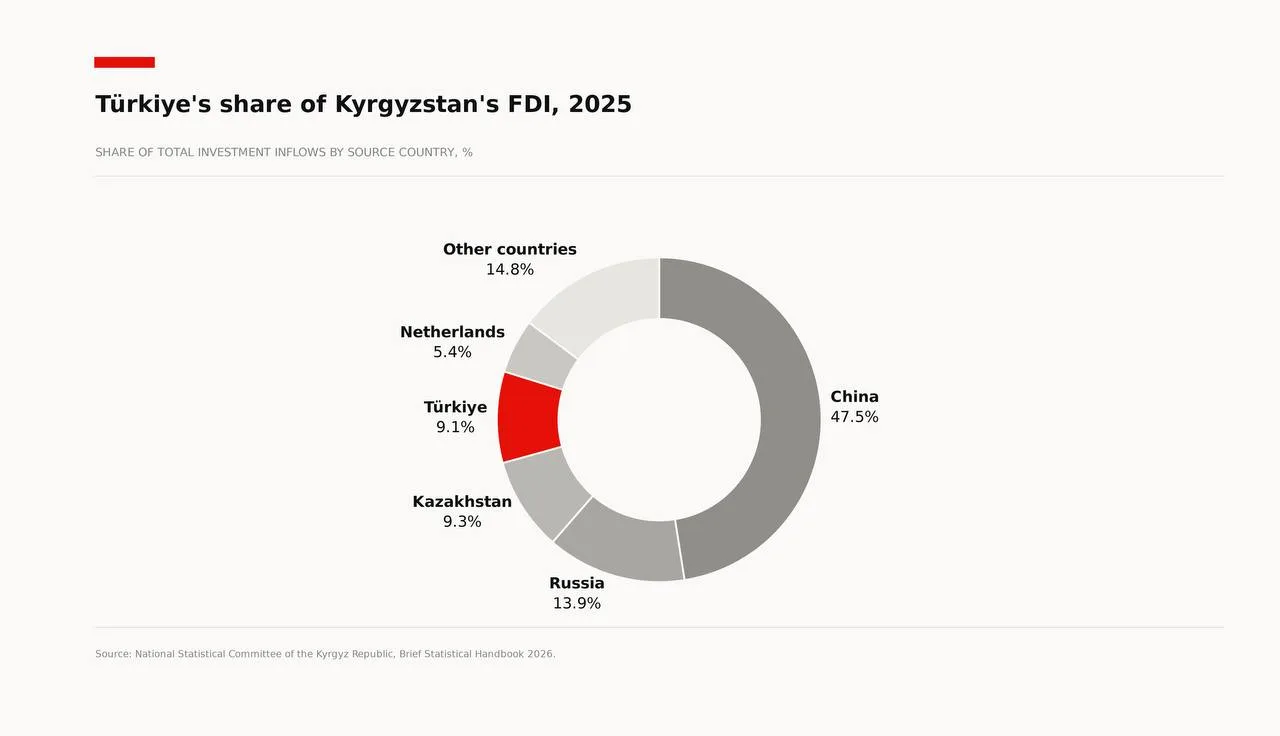
Türkiye rose to become the fourth-largest source of foreign direct investment (FDI) in Kyrgyzstan last year, and the focus of its engagement is changing. Bilateral ties are moving from trade towards long-term projects in energy, industry and transport — the kinds of commitments that shape an economy for decades.
According to the National Statistical Committee of the Kyrgyz Republic, Türkiye's share of gross foreign direct investment inflows into Kyrgyzstan rose from 5.5% in 2024 to 9.1% in 2025, while overall FDI into Kyrgyzstan grew by 27.3% to USD 1.31 billion. This growth builds on a broad business presence, with around 350 Turkish companies operating in Kyrgyzstan and accumulated Turkish investment exceeding USD 1.4 billion.
That presence rests on a comprehensive strategic partnership, which the two governments support through standing institutions. The High-Level Strategic Cooperation Council brings the presidents together to set shared goals, and the Kyrgyz-Turkish Intergovernmental Commission on Trade and Economic Cooperation turns them into joint action plans. Development cooperation has supported the partnership for more than three decades, with the Turkish Cooperation and Coordination Agency (TİKA) having carried out more than 1,000 projects in Kyrgyzstan worth USD 88 million from 1993 to October 2025.
At last year’s Kyrgyz-Turkish business forum, the two sides identified energy, agriculture and food processing, transport and logistics, IT and digital services, and tourism as priority areas for Turkish investment in the country. This agenda is supported at the diplomatic level, with the countries pledging to deepen bilateral ties across connectivity, trade and investment as part of a strategic cooperation programme for 2027-2028.
Hydropower at scale
Energy is where the partnership has produced its largest projects, and Kyrgyzstan's geography explains why. Mountains cover 94% of the country, and their fast-flowing rivers are well suited to generating electricity. Only around 15% of the country’s hydropower potential is in use today, which creates vast opportunities for long-term projects.
This potential has become the basis for the largest Turkish investments in the country. For Türkiye, the projects match its Medium-Term Programme for 2026–2028, which supports closer economic ties with Central Asia and Türkiye's development as a regional energy-trading hub.
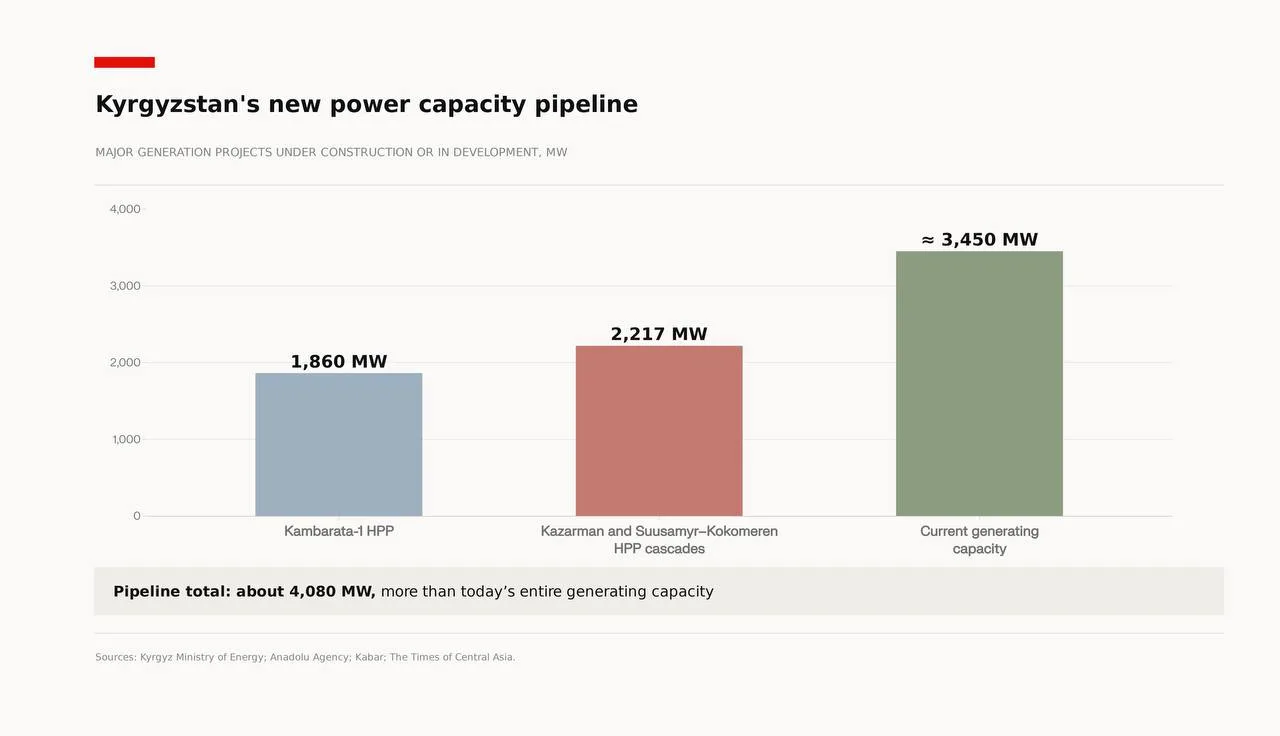
The largest of these projects is a landmark USD 6.2 billion agreement with Türkiye’s Orta Asya Investment Holding to build six hydropower plants across two cascades with a combined capacity of 2,217 MW. According to the company, this marks one of the most significant private-sector energy investments in the region and is a major step forward for Central Asia’s clean energy transition.
The two cascades are developing in sequence. Construction of the first, the 912 MW Kazarman cascade, began in 2026 and is scheduled for completion by 2031, while the second, the 1,305 MW Suusamyr–Kokomeren cascade, is at the feasibility study stage with financing from the Eurasian Development Bank (EDB). When both cascades are in operation, the new hydropower plants are expected to increase Kyrgyzstan's installed capacity by more than 50%.
Manufacturing, agriculture and new sectors
Manufacturing is the largest destination for foreign capital in Kyrgyzstan, attracting 47.2% of total FDI in 2025. Turkish companies invest in this sector mainly across food and beverages, as well as rubber and plastic products. They are also looking at new areas, with companies holding talks on localising the production of medicines and supplements in Kyrgyzstan, including export opportunities.
In agriculture, Turkish technology is helping farmers in Kyrgyzstan use water more efficiently. The agricultural equipment manufacturer AKPLAS has invested in the construction of a 10-hectare site to produce drip and sprinkler irrigation equipment for local farmers.
Turkish companies are also turning to infrastructure and digital channels that connect Kyrgyz producers to their markets. This year, Turkish engineering group Yapı Merkezi held investment and financing talks on railway, bridge, tunnel and green infrastructure projects, in step with Kyrgyzstan's connectivity agenda. Türkiye's Ministry of Trade, in its 2026 market report on Kyrgyzstan, identified e-commerce platforms, digital payments and cross-border delivery as additional opportunities for Turkish firms.
Trade corridors and the Turkic world
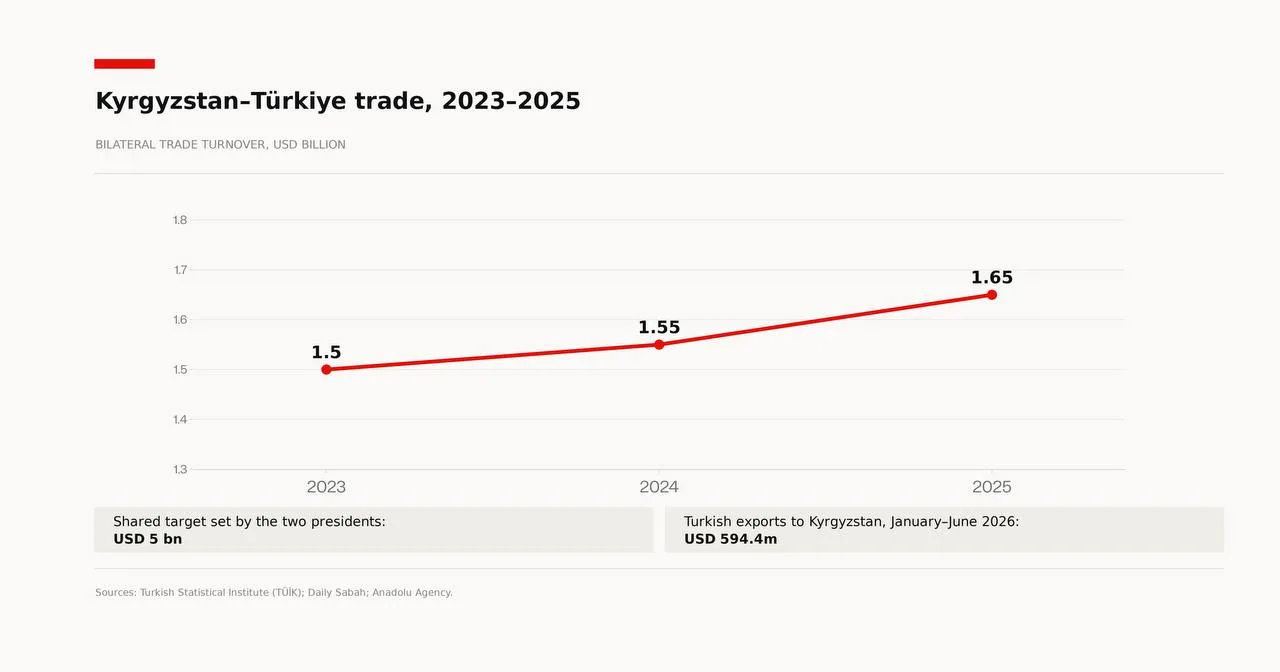
Trade underpins investment, and the two countries have set a major ambition: to reach a target of USD 5 billion in bilateral trade, around three times the 2025 level of USD 1.6 billion.
Türkiye and Kyrgyzstan pursue their agenda as part of the intergovernmental Organisation of Turkic States (OTS), which promotes cooperation among Turkic-speaking nations. The priorities of its Turkic Investment Fund, from renewable energy, logistics and infrastructure to industry, ICT, tourism and SMEs, match the sectors where the two countries already work together.
Growing trade between the countries also depends on the routes that carry it, and the OTS Turkic World Vision 2040 sets out to make the Middle Corridor the fastest, safest and most cost-efficient route between Asia and Europe. For Kyrgyzstan, the gateway to this corridor will be the China–Kyrgyzstan–Uzbekistan railway, bringing Kyrgyz and Turkish markets closer together.
Bishkek is taking an active part in developing the agenda for the 13th OTS summit, to be held in Ankara on 29-30 October 2026. Earlier this month, the Kyrgyz capital hosted a panel to discuss closer coordination along the Middle Corridor. The proposal to establish an institute of logistics and connectivity of the Turkic world in Bishkek would give Kyrgyzstan a lasting role in shaping the routes that carry trade across the region.
Building for the long term
For Türkiye and Kyrgyzstan, a growing focus on investment builds on existing bilateral trade and manufacturing ties to advance both countries’ development priorities.
Kyrgyzstan’s investment potential will be further supported by the launch of Tamchy SFIT, which is creating a new legal and regulatory jurisdiction for international projects and connecting global business to a fast-growing and progressively connected region. As Kyrgyzstan increasingly attracts investment from Türkiye and beyond, Tamchy SFIT unlocks additional opportunities for their long-term growth.